
The Sugarhouse Streetcar Project
- Date: 8/15/2014
- Project Type: Construction Phases
The Sugarhouse Streetcar Project
Challenge
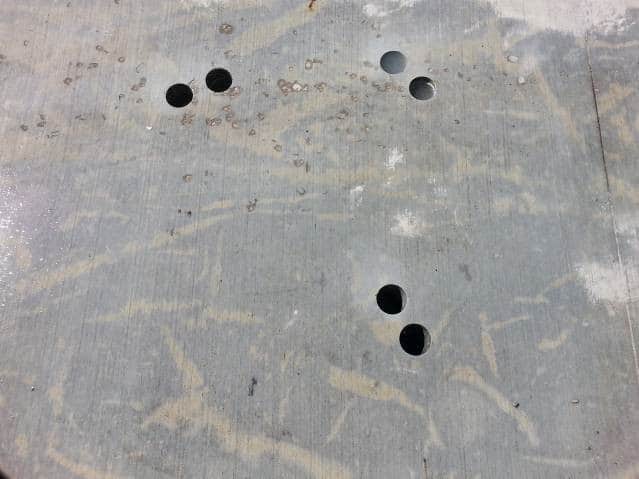
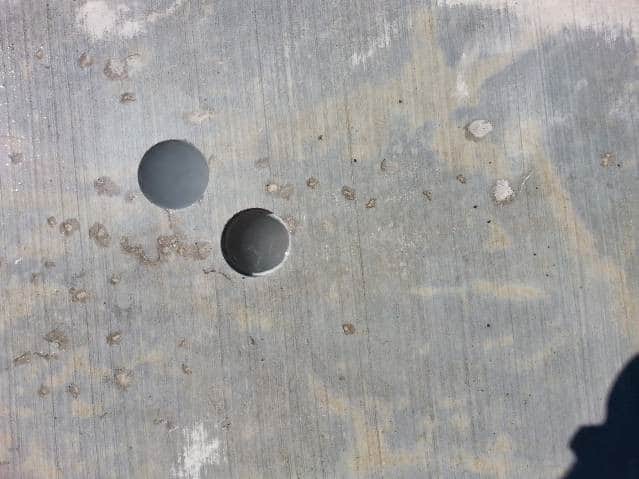
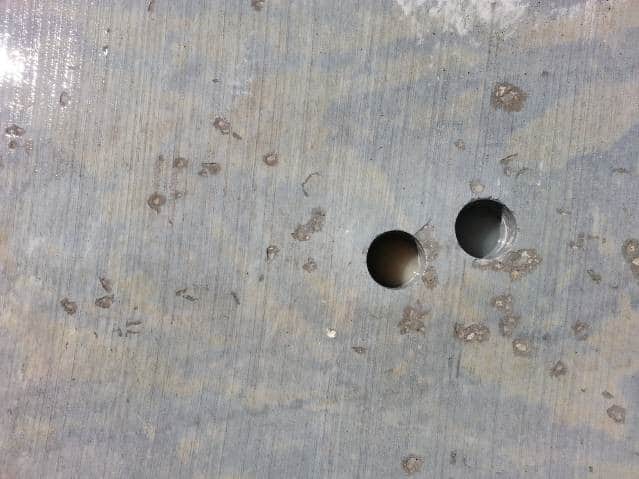
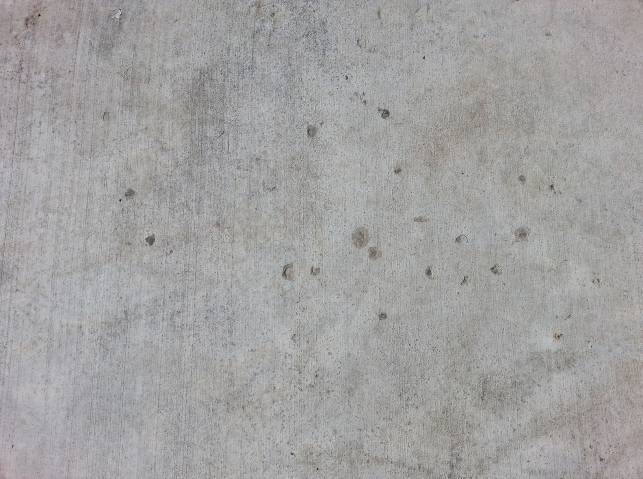
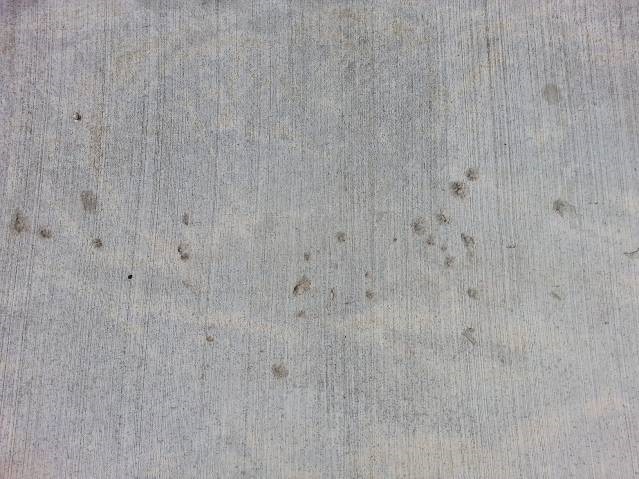
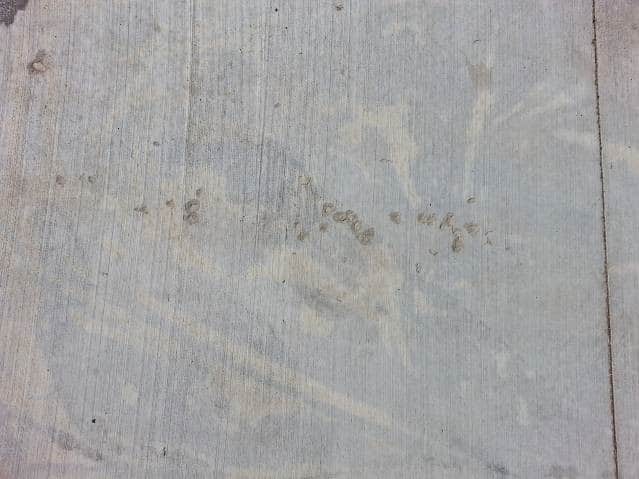
Concrete placed approximately 9–12 months earlier for the Sugarhouse Streetcar Project in Salt Lake City, Utah, developed sporadic surface defects, including areas where aggregate was exposed. Project stakeholders needed to determine the cause of the defects and assess the condition of the concrete.

Services Performed
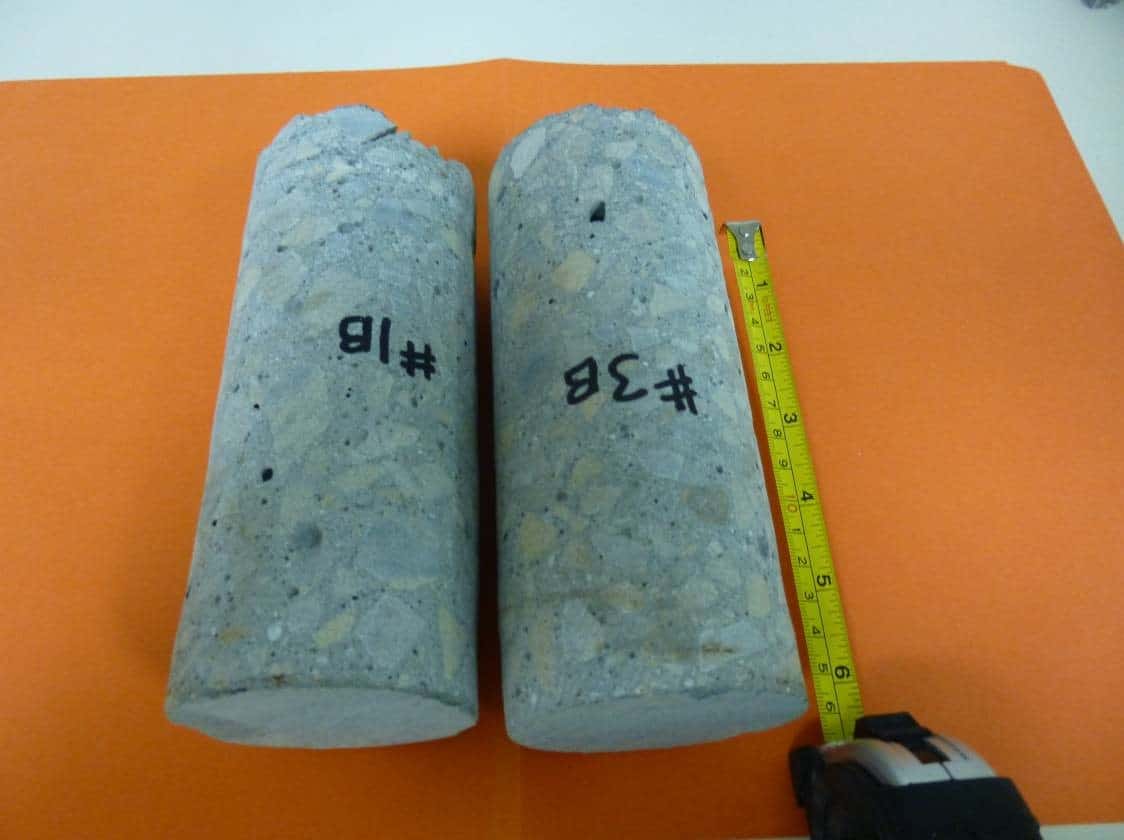
C3S, Inc. evaluated two representative concrete cores from affected areas and performed a detailed petrographic investigation to assess the concrete’s composition, condition, air-void system, aggregate characteristics, and potential deterioration mechanisms.
Testing Methods
ASTM C856 — Petrographic Examination of Hardened Concrete
The examination included:
- Optical microscopy at low and high magnification
- Evaluation of cement paste hydration
- Approximate water-to-cement ratio
- Fine and coarse aggregate composition
- Air-void characteristics
- Cracks and microcracks
- Aggregate condition
- Potential deleterious reaction products
- Mineral admixtures
Findings
Petrographic examination showed that the cement paste was generally well hydrated and uniform. The estimated water-to-cement ratio was approximately 0.46–0.48, with cement content estimated at 5½ ± ½ sacks per cubic yard.
The concrete contained approximately 8–9% entrained air and 4–5% entrapped air. The entrapped air included larger voids and honeycomb-like areas associated with chipped sections of coarse aggregate.
The coarse aggregate was predominantly quartzite, with some particles exhibiting porosity and cracking. No deleterious reaction products or cracks were identified in the cement paste.
Outcome
C3S, Inc. determined that the observed surface defects were likely associated with two primary factors:
- Elevated entrapped air content and honeycombing, estimated at approximately 4–5%, including voids associated with chipped coarse aggregate.
- Porous and cracked coarse aggregate, which contributed to irregular voids within the concrete.
The investigation provided the project stakeholders with a technical assessment of the concrete condition and identified the probable factors contributing to the observed surface defects.
Featured Service: Petrographic Examination of Hardened Concrete (ASTM C856)
Photomicrographs from the petrographic analysis are shown
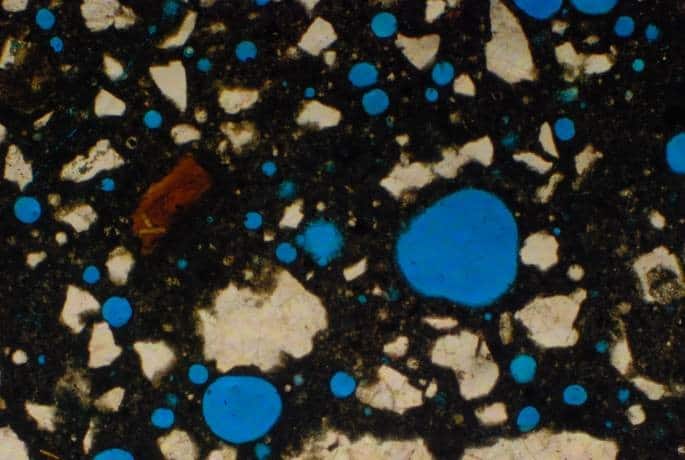
Figure 6a
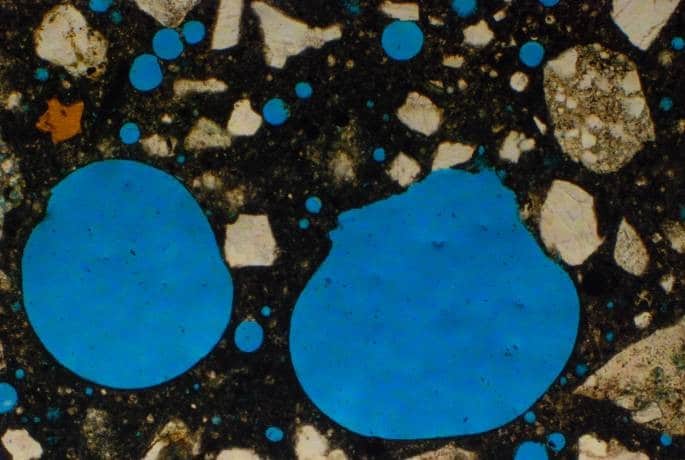
Figure 6b
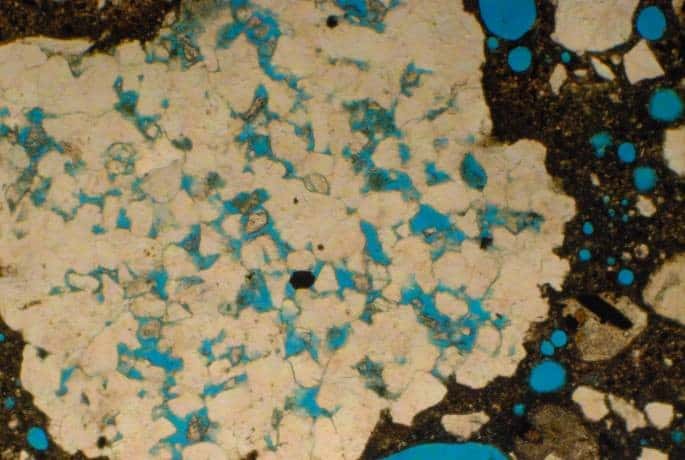
Figure 6c
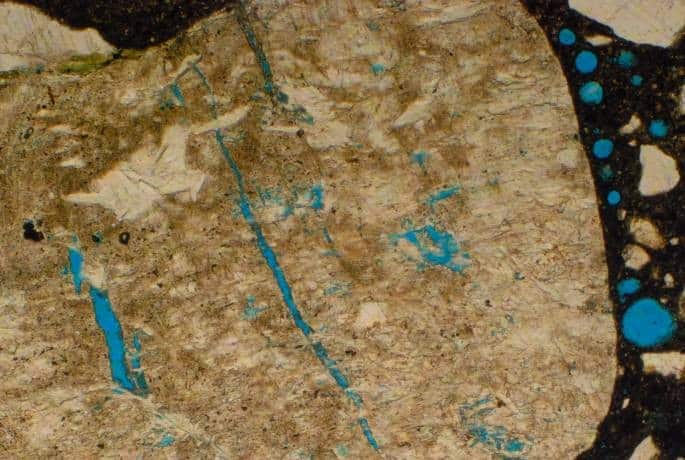
Figure 6d
Figure 6 shows representative sections of Sample 1B.
Small-sized voids (blue round circles) fitting the size of entrained air voids are shown in Figures 6 a, b, c & d.
Larger-sized voids fitting the size of entrapped air are shown in Figure 6 b (yellow arrow)
Pores and cracks in aggregate are shown in Figure 6 c & d respectively.
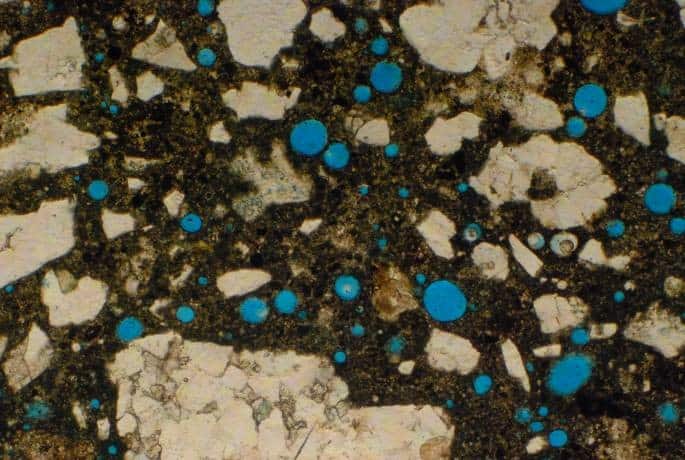
Figure 7a
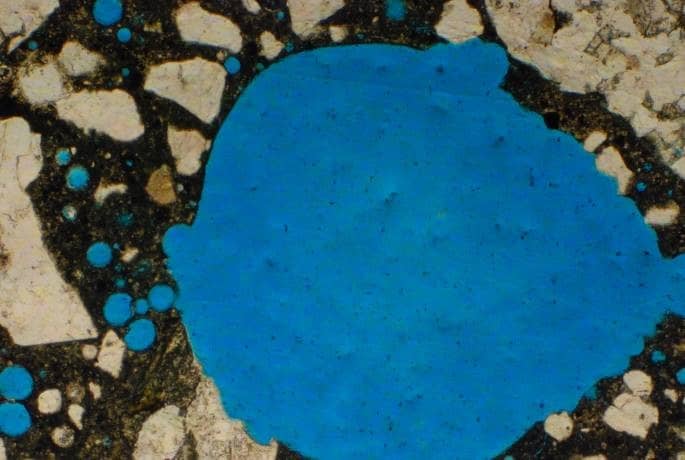
Figure 7b
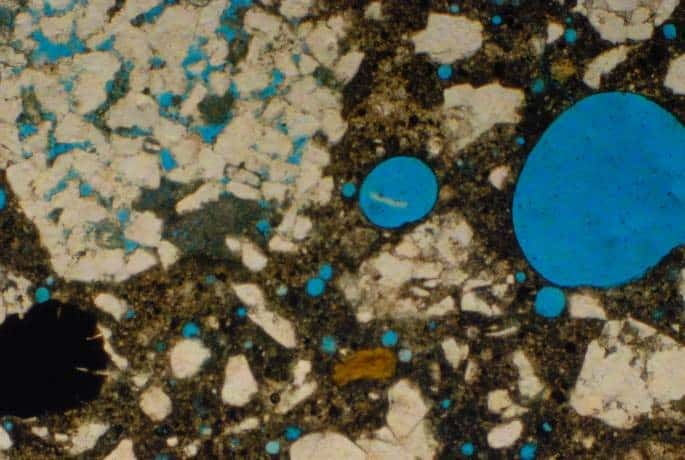
Figure 7c
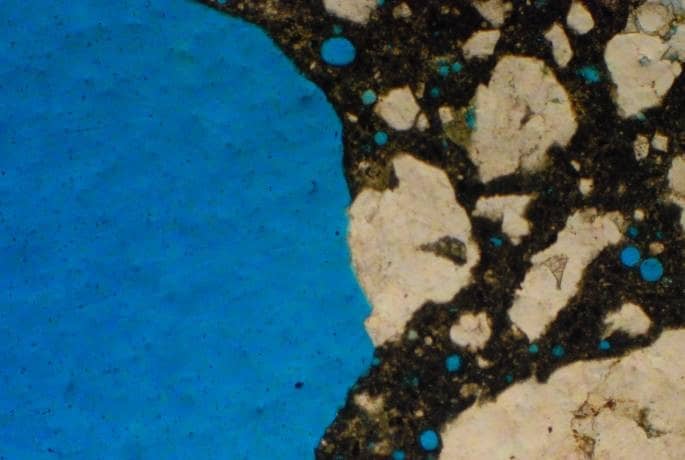
Figure 7d
Entrained air void sized shown in Figures 7a, b, c & d.
Entrapped air sized voids (red arrow) is shown in Figure 7c.
Large air voids resulting from chipped off sections of coarse aggregate are seen in Figures 7b & d
Porous aggregate is shown in Figure 7c. (Yellow arrow)
DISCUSSION OF RESULTS
The noted defects are likely to be a combination of two factors, and they are:
- High entrapped air content/honeycombs, estimated at 4-5%. This includes voids from chipped off sections of coarse aggregate (see Figure 7 b & d), and
- Porous and cracked aggregate. Aggregate used in concrete is expected to be devoid of deposits, hard and strong. The aggregate used in the concrete was found to be porous and/or cracked. The cracks contributed to the entrapped air voids of varying sizes in the concrete.
The estimated entrained air content of 8 – 9% is sufficient to resist frost (freeze-thaw); for concrete with 1” maximum size coarse aggregate about 6% entrained air is recommended in severe exposure environment [2]. Entrained air void sizes are typically in the range of 10 µm to 100 µm (0.1mm) in diameter.
Entrapped air voids are 1000 µm (1mm) or larger in size and are estimated to be 1 – 2% in a well compacted concrete [3]. Kosmatska [4] attributes entrapped air voids to be a function of aggregate characteristics for a 1” maximum-size aggregate in a non-air-entrained concrete the estimated entrapped air is about 1.5%
[3] Composition and Properties of Concrete, Troxell G.E., Davis H.E. and Kelly J.E., McGraw-Hill Book Company, Second Edition, 1968
[4] Design and Control of Concrete Mixtures, Kosmatka S.H and Wilson, M.L. Portland Cement Association Engineering Bulletin 001, 15th Edition, 2012
Get Expert Answers for Your Concrete Challenges
Not sure what’s causing your concrete issue? Our specialists provide clear, data-backed insights to help you make the right decision fast and confidently.

Consulting Engineers
Concrete Experts
CONTACT INFORMATION
C3S, Inc.
7100 Regency Square Blvd.
Suite 183
Houston, TX 77036