
Aggregate Matters:
Condition Assessment of Concrete Piles
Stakeholders were concerned about cracks and patches of surface delamination on a concrete slab shortly after concrete placement and contracted C3S, Inc. to evaluate and advise.
- Date: May 2020
- Project Type: Maintenance/Forensic Phase
Aggregate Matters: Condition Assessment of Concrete Piles
About this Project
Project Name: Evaluation of Concrete Piles
Location: Docks 40-41, Port of Texas City, Texas
As part of the periodic evaluation of concrete structures at the Port of Texas City, the Port, together with its engineering consultant LJA Engineering, engaged C3S, Inc. to evaluate the concrete piles supporting the platforms at Docks 40–41.
The evaluation was required to determine the current durability and condition of the piles and assess visible cracks and surface defects.
-
Services Performed
C3S, Inc. performed a comprehensive condition and durability assessment of the concrete piles, including:
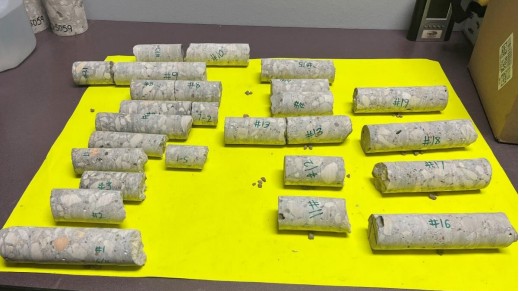
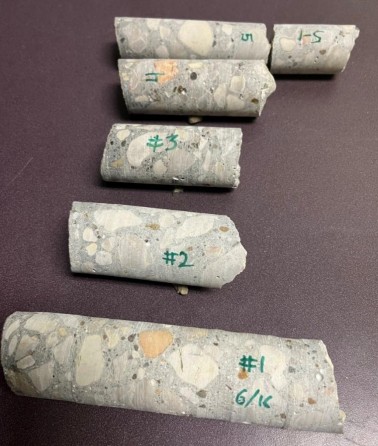
- Extraction and evaluation of concrete cores.
- Ground-penetrating radar (GPR) scanning to locate embedded reinforcing steel before coring.
- Compressive strength testing.
- Petrographic examination.
- Scanning electron microscopy (SEM).
- Carbonation testing.
- Evaluation of cracks, aggregates, cement paste, and potential deterioration mechanisms.
A total of 19 cores were extracted, with core dimensions restricted by the location of embedded reinforcement.
Testing Methods
The durability evaluation included four primary tests:
-
- ASTM C42 — Compressive Strength of Concrete Cores
- ASTM C856 — Petrographic Examination of Hardened Concrete
- ASTM C1723-10 — Scanning Electron Microscopy (SEM)
- Carbonation Testing — evaluation of the concrete’s alkalinity and protection of embedded reinforcement.
A. Compressive Strength, ASTM C42
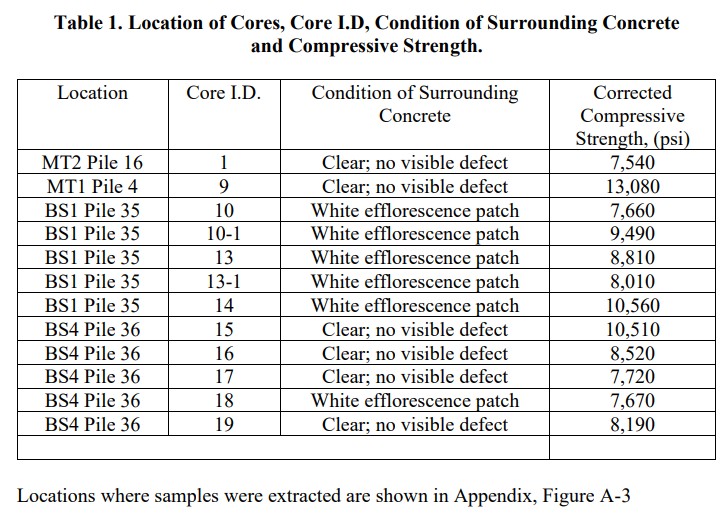
The test method provides standardized procedures for obtaining and testing specimens of concrete to determine the compressive strength of the in-place concrete. Due to configuration of embedded rebars, as revealed by ground penetrating radar technique, the expected 3.7” diameter cores could not be retrieved from the piles due to potential of cutting through rebars. A 1-5/8” diameter was considered safe to avoid any potential damage to embedded rebars.
Petrographic Examination of Hardened Concrete, ASTM C 856
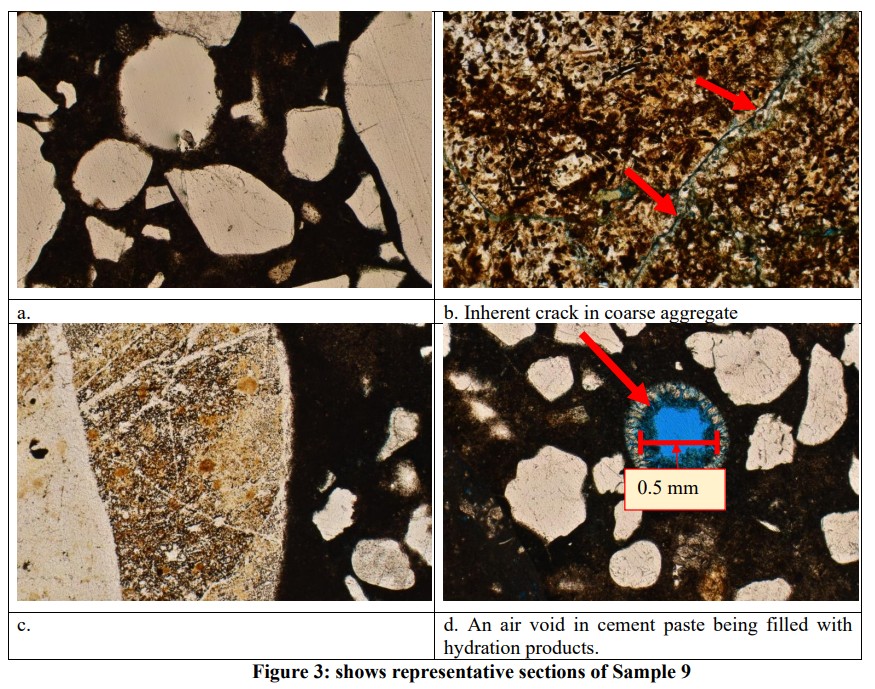
Petrographic analysis involve the optical examination of concrete specimen under low and highpower magnification. Detailed instructions on conducting a petrographic examination of hardened concrete/mortar can be found in ASTM C856, “Standard Practice for Petrographic Examination of Hardened Concrete”. For examination, a section of the mortar was impregnated with blue dye under vacuum. The impregnation under vacuum causes the dye to permeate every crack, micro crack, and all pores, including micro pores in the concrete sample. The impregnated concrete is cut and placed on a glass plate, ground and polished to a thickness of about 30 microns. The samples were then with by polarizing microscope using a 400X magnification.
Purpose of Petrographic Examination
The usefulness of petrographic analysis ranges from quality control to predicting future performance of concrete; others include:
- Determination of the causes of inferior quality, distress, or deterioration of concrete/mortar in a construction.
- Determination of cause(s) of a well performing concrete in service.
- Part of a survey of the safety of a structure for a present or proposed use.
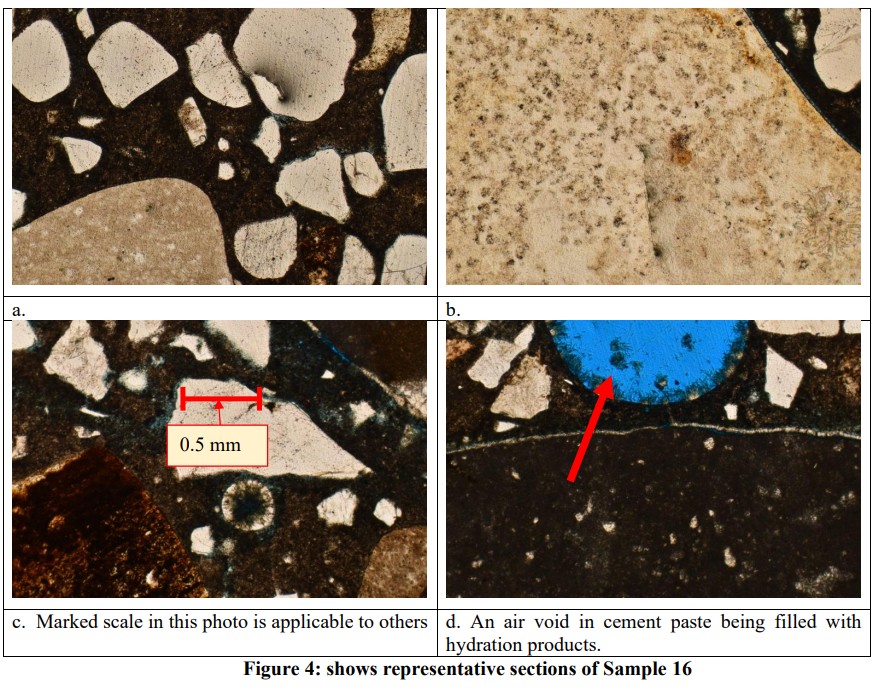
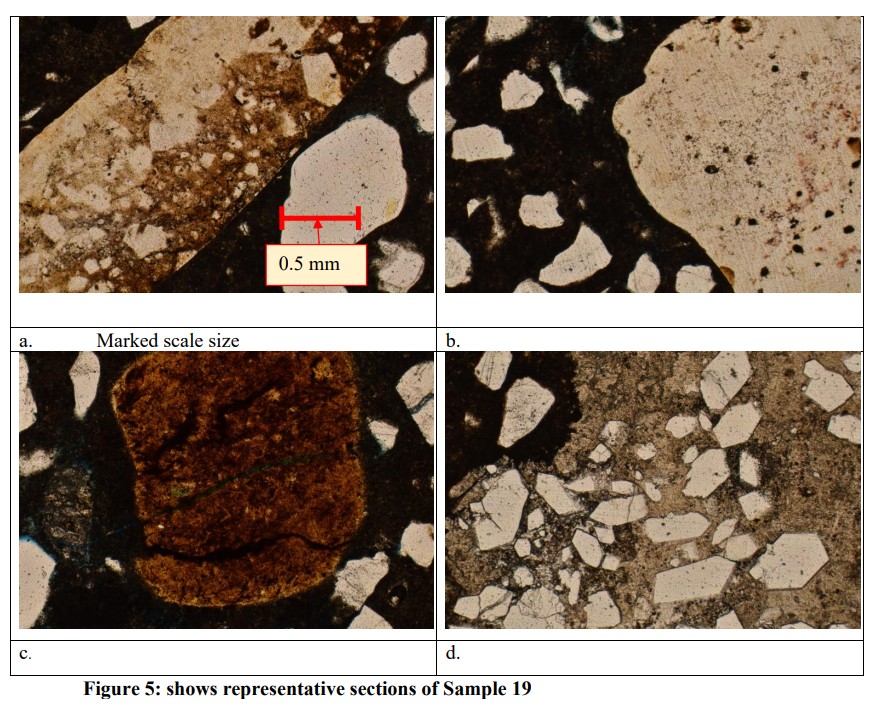
Findings from Petrographic Analysis (Samples 9, 16 and 19)
- The cement pastes in all three Samples examined were dense and uniform, indicative of concrete formulated with optimal water to cement ratio. The dense paste effectively surrounded both coarse and fine aggregates giving rise to a dense compact matrix.
- A few of the coarse aggregates had inherent cracks in them but cracks have not extended into the dense, hardened cement paste.
- Entrained air voids, with hydration products surrounding the inner lining, were noted in some of the samples examined as shown in Figure 3d and 4d.
C. Scanning Electron Microscopy, (SEM) ASTM C1723-10
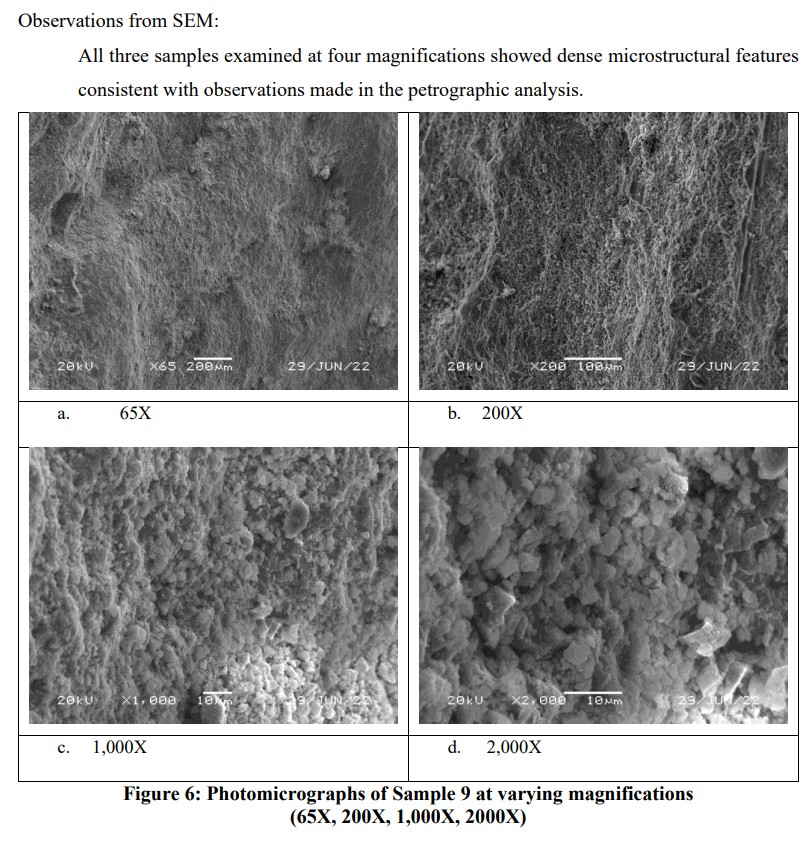
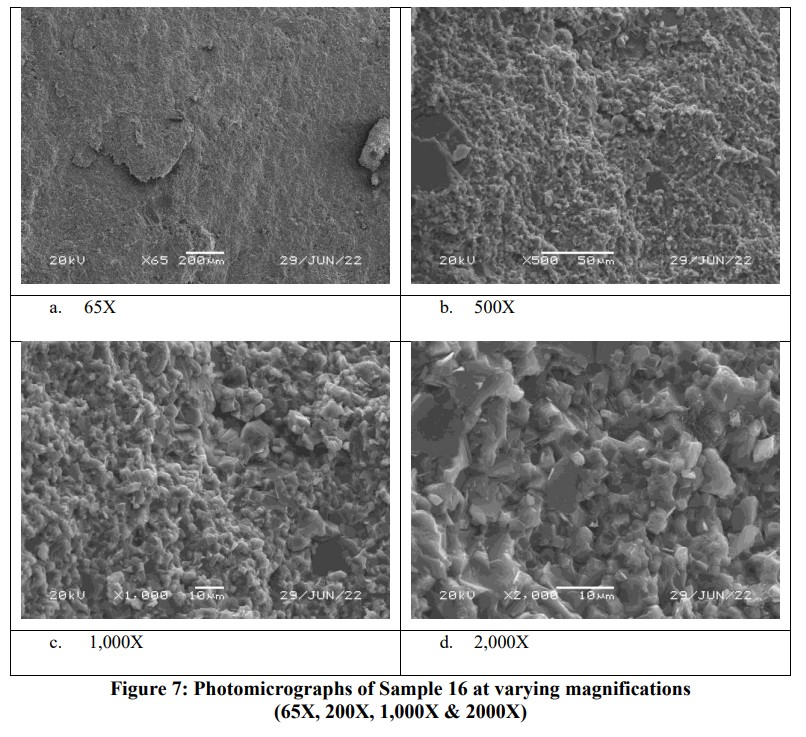
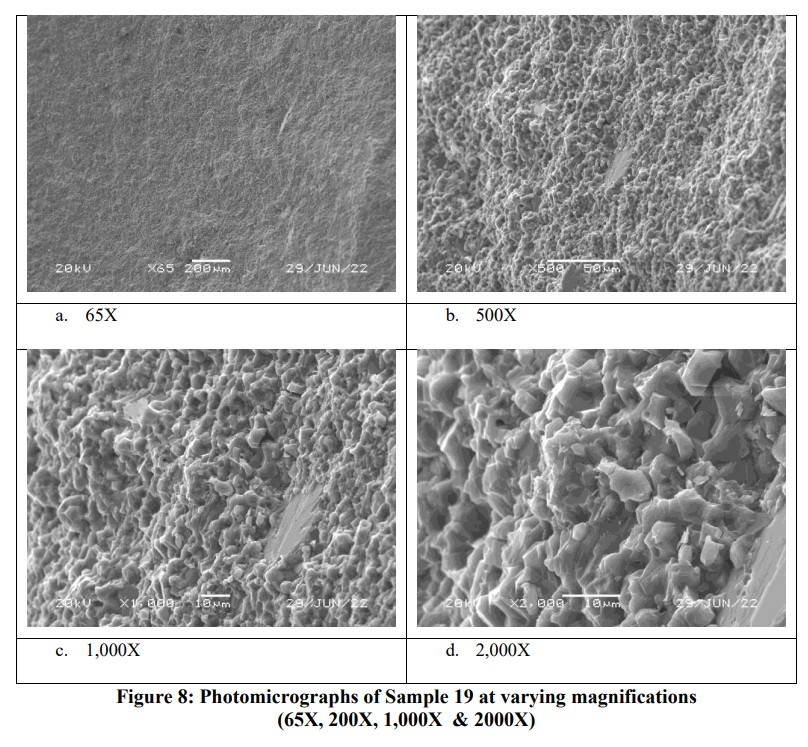
Scanning electron microscopy (SEM), is used in the evaluation of several materials, including concrete. It uses electron beams as part of the analytical microscope system to examine concrete samples in magnifications ranging from 15X to over 5,000X. In concrete samples, SEM allows details such as fly ash particles and hydration products to be clearly viewed. SEM is also often used to compliment petrographic analysis of hardened concrete as per ASTM C 856 method.
D. Carbonation Test
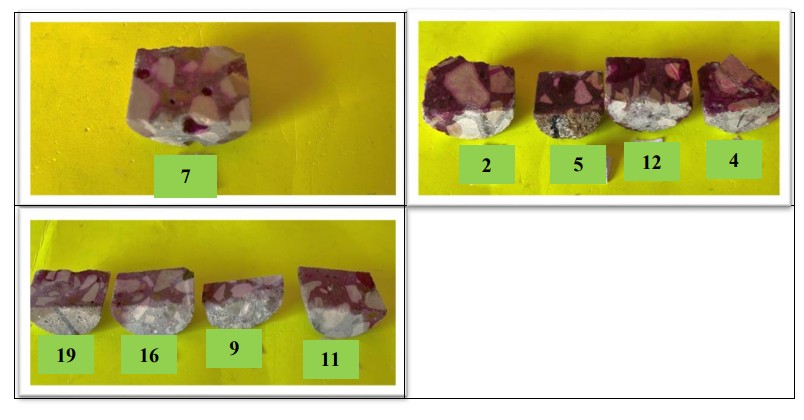
Carbonation is a process in which moisture-laden carbon dioxide from the atmosphere diffuses through the pores of concrete and through a chemical reaction, converts the calcium hydroxide into calcium carbonate. This reaction lowers the pH of concrete in the areas concerned, typically on the surface of concrete. The process can continue to progressively penetrate the concrete depending on the porosity of the concrete.
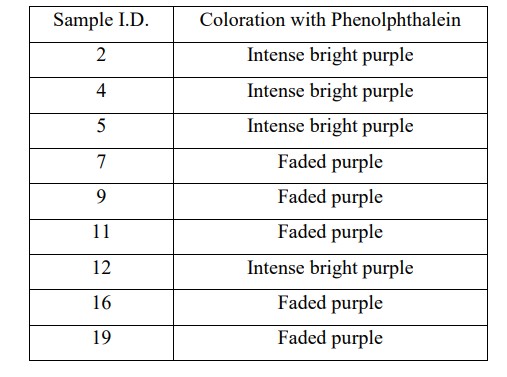
The reagent commonly used is phenolphthalein. When in contact with high pH (>10) concrete, the phenolphthalein solution shows as bright pink color; with low pH (<10), the solution shows no color change. A gray concrete color is noted on the top surface of the concrete representing the carbonated area, typically measured in fractions of an inch.
Samples tested for carbonation are 2, 4, 5, 7, 9, 11, 12, 16, 19
Findings
Compressive strength testing indicated strong in-place concrete, with reported values ranging from approximately 7,600 to 13,000 psi.
Petrographic examination showed dense, uniform cement paste effectively surrounding the coarse and fine aggregates. Some coarse aggregate particles contained inherent cracks, but these cracks had not propagated into the surrounding hardened cement paste. No deleterious reaction products were identified.
SEM examination confirmed the presence of a dense cement paste and did not identify deleterious reaction products in the samples evaluated.
Carbonation testing indicated that the concrete cover remained highly alkaline, providing good protection for the embedded reinforcing steel.
Outcome
Based on the four durability indicators, C3S, Inc. determined that the concrete piles were generally in good condition. The evaluation indicated that the primary repairs required were limited to visible cracks and surface defects on affected piles, rather than evidence of widespread internal concrete deterioration.
Featured Services:
- Concrete Condition Assessment
- Concrete Core Testing
- GPR Scanning
- Compressive Strength Testing
- Petrographic Analysis
- SEM Analysis
- Carbonation Testing
Get Expert Answers for Your Concrete Challenges
Not sure what’s causing your concrete issue? Our specialists provide clear, data-backed insights to help you make the right decision fast and confidently.

Consulting Engineers
Concrete Experts
CONTACT INFORMATION
C3S, Inc.
7100 Regency Square Blvd.
Suite 183
Houston, TX 77036