

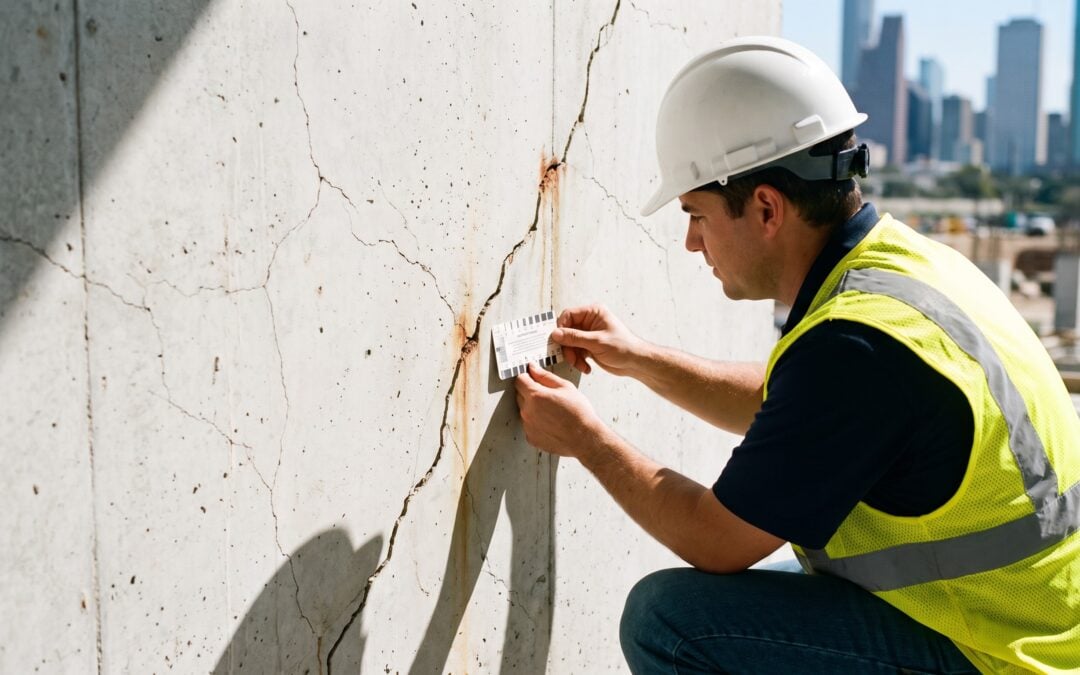
Every concrete structure cracks. Slabs, walls, parking decks, foundations and pavements all develop cracks at some point in their service life. For a property manager or facility owner, the real question is not whether a crack exists. It is whether that crack is a cosmetic blemish or an early signal of a structural problem that will become more expensive with every month it is ignored.
Guessing is costly in both directions. Treat a structural crack as cosmetic, and a manageable repair can grow into a major one. Treat a cosmetic crack as structural, and you may spend heavily on work the building never needed. A disciplined evaluation replaces assumptions with evidence.
Why Concrete Cracks in the First Place
Concrete is strong in compression but relatively weak in tension. When tensile stresses exceed what the concrete can carry, it cracks. Those stresses come from several sources, and the source determines whether a crack matters.
Shrinkage Cracks
As concrete dries and cures, it loses moisture and shrinks. When that shrinkage is restrained by the subgrade, reinforcement or adjacent elements, fine cracks form. Plastic shrinkage cracks can appear within hours of placement, especially in hot, windy conditions. Drying shrinkage cracks develop over weeks and months. In most cases these cracks are narrow, shallow and stable, and they are primarily a durability and appearance concern rather than a structural one.
Thermal Cracks
Concrete expands and contracts with temperature. In Houston, large daily and seasonal temperature swings on exposed slabs, decks and walls create movement that must be accommodated by joints. Where joints are missing, poorly spaced or not cut in time, the concrete creates its own joints in the form of cracks.
Settlement Cracks
When the soil beneath a slab or foundation consolidates, shifts or loses support, the concrete above it moves. Expansive clay soils, common across the Gulf Coast region, swell when wet and shrink when dry. Settlement cracks often show vertical offset, meaning one side of the crack sits higher than the other, and they tend to widen over time.
Structural Cracks
Structural cracks result from loads the element was not designed to carry, design or construction deficiencies, loss of reinforcement capacity or overloading. Their location and pattern usually relate directly to how the member carries load, such as cracks near supports, at mid-span of beams and slabs, or diagonal cracks near columns and walls.
Cracks Caused by Deterioration
Some cracking is a symptom of a material problem inside the concrete. Corrosion of reinforcing steel, alkali-silica reaction, sulfate attack and freeze-thaw damage all generate internal expansion that cracks concrete from within. These mechanisms are progressive. Left unaddressed, they continue to damage the structure and often accelerate.

Warning Signs That Call for an Engineer
Not every crack requires an investigation, but the following conditions should never be dismissed as cosmetic:
- Cracks that are growing. A crack that widens, lengthens or multiplies over weeks or months indicates active movement.
- Vertical or horizontal offset. When one face of a crack is displaced relative to the other, the element is moving or settling.
- Rust staining. Brown or orange staining along a crack line often indicates corroding reinforcement beneath the surface.
- Spalling or delamination. Concrete that sounds hollow when tapped, or pieces breaking away from the surface, point to internal deterioration.
- Diagonal cracking near supports. Diagonal cracks in beams, walls or near columns can indicate shear distress.
- Map or pattern cracking. A random, interconnected crack network across a surface can signal alkali-silica reaction or other material distress.
- Doors, windows or equipment that no longer align. Functional problems in a building often accompany structural movement.
- Water infiltration. Cracks that leak in parking structures, basements, tanks or reservoirs allow moisture and chlorides to reach the steel.

How a Forensic Evaluation Answers the Question
A proper evaluation does not stop at describing the crack. It determines the cause, the extent of the problem and whether the condition is active or stable. At C3S, Inc., a typical forensic evaluation of concrete combines several lines of evidence:
- Visual condition survey and crack mapping to document crack widths, patterns, offsets and locations relative to how the structure carries load.
- Non-destructive testing, such as ground-penetrating radar (ASTM D6432), impact echo (ASTM C1383), ultrasonic pulse velocity (ASTM C597) and half-cell corrosion potential (ASTM C876), to locate reinforcement, detect hidden delaminations and assess corrosion activity without unnecessary demolition.
- Core sampling and laboratory testing, including compressive strength (ASTM C42 and C39) and water-soluble chloride content (ASTM C1218 and C1152).
- Petrographic examination of hardened concrete (ASTM C856), which reveals what is happening inside the material, including crack depth, the quality of the paste and aggregate, and evidence of reactions such as alkali-silica reaction.
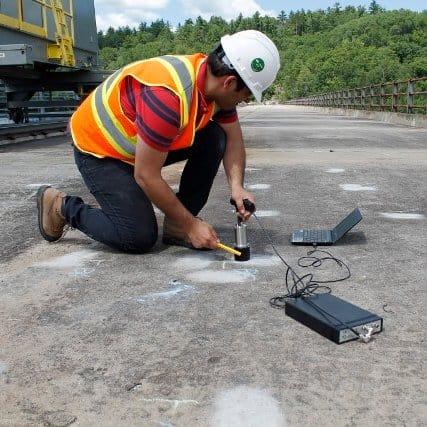
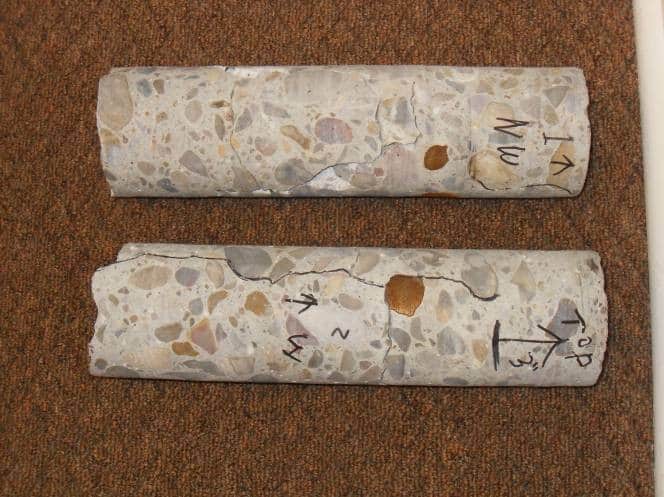
The result is a clear finding: what caused the cracking, whether it threatens structural performance or durability, and what repair approach actually addresses the root cause.
What to Do When You Find a Crack
- Document it. Photograph the crack with a scale or ruler in the frame, and note the date and location.
- Monitor it. Mark the ends of the crack and recheck periodically. Simple crack monitors can track movement over time.
- Do not patch first. Sealing or covering a crack before its cause is understood can hide evidence and allow the underlying problem to continue.
- Bring in an engineer early when any of the warning signs above are present. Early evaluation almost always costs less than a late repair.
Evidence, Not Assumptions
Repair decisions, budgets and, in some cases, legal positions depend on knowing why concrete has cracked. A repair that treats the symptom without the cause rarely lasts. For more than three decades and more than 5,000 analyses, C3S, Inc. has helped owners, agencies and contractors replace uncertainty with defensible, evidence-based answers.
Request an Analysis
If you are seeing cracks you cannot explain, our licensed Professional Engineers and concrete specialists can determine the cause and recommend the right next step. Request an analysis today, call (713) 432-9200, or email services@c3sinc.com.
Recent Comments