

Standards Supporting Reliable Concrete Evaluation
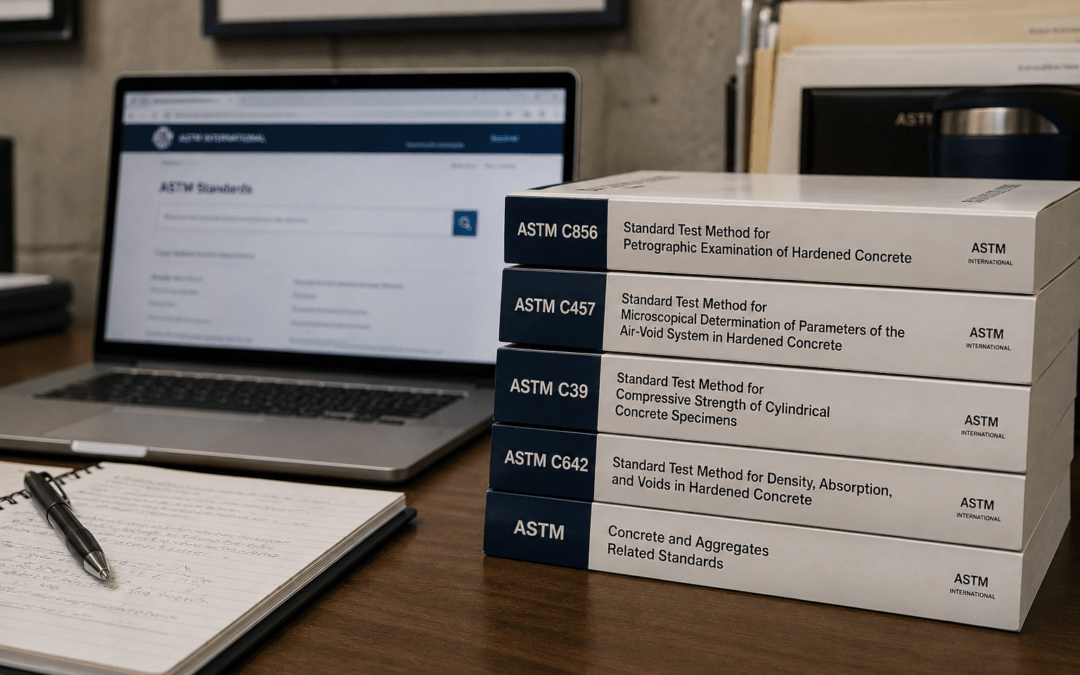
Standardized testing procedures help provide consistency when concrete and construction materials are investigated.
C3S, Inc. applies relevant ASTM standards and established testing methodologies as appropriate to the requirements of each investigation.
Selected ASTM Standards
ASTM C856
Petrographic Examination of Hardened Concrete
Provides procedures for petrographic examination of hardened concrete to evaluate materials, distress, deterioration, and other characteristics.
ASTM C42
Obtaining and Testing Drilled Cores and Sawed Beams of Concrete
Provides procedures for obtaining and testing drilled concrete cores and sawed concrete specimens.
ASTM C39
Compressive Strength of Cylindrical Concrete Specimens
Provides the standard test method for determining the compressive strength of cylindrical concrete specimens.
ASTM C457
Microscopical Determination of Parameters of the Air-Void System in Hardened Concrete
Provides procedures for evaluating air-void characteristics in hardened concrete.
ASTM C642
Density, Absorption, and Voids in Hardened Concrete
Provides procedures for determining density, absorption, and permeable voids in hardened concrete.
Why ASTM Standards Matter
Standards provide established procedures for conducting specific tests. However, testing results must still be interpreted in relation to:
- Project requirements
- Construction history
- Material specifications
- Environmental exposure
- Field conditions
- Observed distress
- Other laboratory results
C3S, Inc. Approach
C3S, Inc. combines standardized testing procedures with engineering judgment, field investigation, laboratory analysis, and forensic interpretation.
Recent Comments